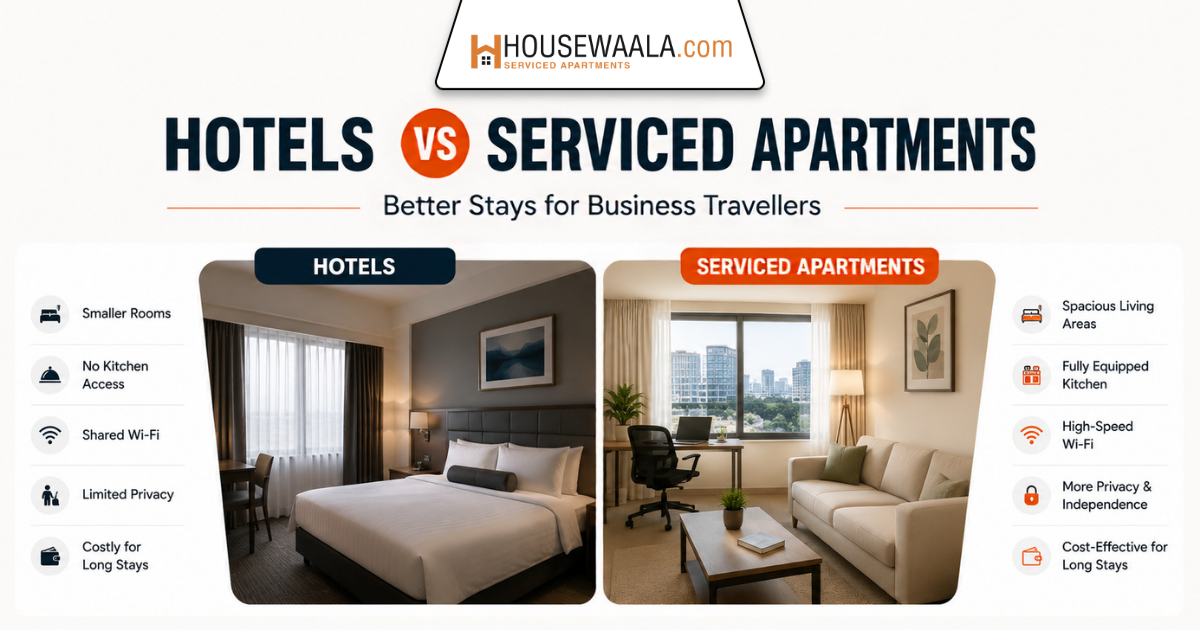
Every business trip starts with the same practical question: where do you actually stay? For a single overnight meeting, the answer barely matters. But once a trip stretches into a week, a month, or an open-ended project, the debate of Hotels vs Serviced Apartments becomes one of the most consequential decisions a business traveller — or the company booking on their behalf — will make.
This guide breaks the comparison down properly across cost, comfort, productivity, privacy, food, laundry, location, and flexibility, so you can settle the question for your next trip with actual data instead of guesswork.
Hotels vs Serviced Apartments: What’s the Difference?
Before comparing the two side by side, it helps to define them clearly, because the terminology gets used loosely.
A hotel is built around short stays — a room, a bed, daily housekeeping, and shared amenities like a restaurant or gym. It’s designed for convenience over a night or two, not for living in for weeks at a stretch.
An apartment-style stay, by contrast, is a fully furnished unit that comes with hotel-style services — housekeeping, support staff, sometimes a front desk — but is built like an actual home, with a separate living area, a working kitchen, and considerably more space than a standard room. This single structural difference drives almost every other point in this comparison, and it’s why the terms corporate housing and extended stay apartments are often used interchangeably with it.
Why Business Travellers Need the Right Accommodation
Business travellers don’t travel to relax — they travel to work. That changes what “good accommodation” even means. A leisure traveller might prioritise a rooftop pool or a scenic view; a professional on a client visit or project deployment cares about a reliable desk, dependable Wi-Fi, and a quiet space to prepare for the next morning’s meeting.
For corporate travellers, the accommodation itself becomes part of the job — the place where calls happen, where documents get reviewed, and where a long week is either made manageable or made harder. That’s why choosing the right business travel accommodation matters more here than in almost any other kind of travel, and why so many companies are re-thinking their default of booking a hotel for every single trip.
Cost Comparison
This is usually where the Hotels vs Serviced Apartments conversation starts, and for good reason.
Hotels are priced per night, and that price rarely drops much even for longer stays. A well-located hotel in a business district can easily run ₹6,000–₹12,000 a night, and even mid-range options add up fast once you’re paying for a full week or month, plus meals, since hotel dining is rarely cheap.
Corporate housing, by contrast, is priced for exactly this kind of stay. Providers of this type of business stay structure their rates around weekly and monthly bookings, which brings the effective nightly cost down significantly. Add in the money saved by cooking a few meals instead of eating out every single day, and the total cost of a multi-week trip in an apartment can come in well below the hotel equivalent — sometimes by 30–40%.
Verdict on cost: For stays under three nights, the difference is negligible. Beyond a week, the serviced apartment vs hotel comparison tips clearly toward the apartment.
Comfort & Living Space
A standard hotel room is built around one function: sleeping. It’s typically 250–350 square feet, with a bed taking up most of it and little room to actually live in.
Furnished apartments flip that ratio. A one-bedroom unit often runs 600–900 square feet, with a separate bedroom, a living room, and a proper dining area. For anyone staying more than a few nights, this difference in space translates directly into comfort — somewhere to sit that isn’t the bed, somewhere to eat that isn’t a tray on your lap.
Verdict on comfort: Apartment-style stays win decisively for any trip longer than three or four nights.
Work Productivity
This is where the productivity gap matters most for anyone travelling for actual work rather than leisure.
Hotel rooms usually offer a small desk wedged into a corner, if at all, with Wi-Fi that’s shared across the entire property and can slow to a crawl during peak hours — a real problem during an important video call. Executive apartments, on the other hand, are typically set up with a dedicated workspace, a proper chair, and a private internet connection that isn’t competing with hundreds of other guests.
For corporate travellers who need to work from their accommodation — not just sleep in it — this single factor often settles the decision on its own. It’s also one of the clearest arguments in the broader serviced apartment vs hotel debate for anyone on a project deployment rather than a quick visit.
Privacy
Hotels come with constant foot traffic: shared corridors, room service knocks, housekeeping visits on a fixed schedule, and neighbours on both sides. None of it is a dealbreaker for one night, but over a longer stay it adds up.
Apartment-style corporate housing offers a level of privacy closer to renting your own flat. There’s no shared lobby traffic through your living space, housekeeping visits can usually be scheduled around your day rather than a fixed hotel timetable, and you’re not sharing walls with a rotating cast of strangers every few nights.
Verdict on privacy: This type of stay offers a meaningfully quieter, more controlled environment than a comparable hotel.
Food & Kitchen Facilities
Hotels solve food with room service or an on-site restaurant — convenient, but expensive and repetitive over time, and rarely flexible enough for anyone with specific dietary needs or preferences.
A working kitchen is one of the most underrated advantages of choosing an apartment over a hotel room. Being able to make your own breakfast, keep basic groceries on hand, or reheat leftovers after a late meeting isn’t a luxury on an extended trip — it’s a genuine quality-of-life difference. It also means a business stay doesn’t have to mean three restaurant meals a day for weeks in a row.
Verdict on food: Apartment-style accommodation gives you control that a hotel simply can’t match.
Laundry Facilities
Hotel laundry service exists, but it’s typically priced per item and can turn a simple shirt-and-trousers wash into an unexpectedly expensive line item on your expense report.
Most units built as an apartment hotel either include an in-unit washing machine or offer laundry as part of the package at a flat, predictable rate. For a trip longer than a week, this alone can save a meaningful amount — and a lot of hassle.
Location
Hotels tend to cluster in a handful of predictable areas — airport zones, city centres, convention districts — which is convenient if your meetings happen to be nearby, and inconvenient if they don’t.
Apartment-style options are typically spread across a wider range of residential and business neighbourhoods, which often makes it easier to find accommodation for business travel genuinely close to your specific office or client site, rather than settling for whichever hotel cluster is nearest. This is one of the more overlooked advantages in the wider Hotels vs Serviced Apartments conversation — proximity often matters more than the property type itself.
Flexibility
Business trips rarely go exactly as planned. Meetings get extended, projects run longer than scoped, flights get rebooked. Hotels can accommodate some of this, but usually at a premium — extending a hotel stay at the last minute often means paying the full rack rate for the extra nights.
Providers of long stay accommodation are generally more used to this kind of shift. Many offer flexible extensions, and because their base pricing is already built around weekly and monthly terms, extending a stay doesn’t come with the same financial penalty a hotel would apply. This is a big part of why so much business travel accommodation is now booked through apartment providers rather than hotel chains for anything beyond a fixed one-week trip. Even a simple short term rental booked through this kind of provider tends to be easier to extend than a hotel reservation made through a standard booking platform.
Long-Term Stay Benefits
For anything beyond two or three weeks, the case for extended stay apartments becomes hard to ignore. Beyond the cost savings already covered, there’s a psychological benefit too — having a consistent, private space to return to every evening makes a long trip feel less like an endless series of hotel nights and more like a temporary home. For corporate travellers on relocation assignments or multi-month projects, this stability genuinely affects how well they function day to day, and it’s a major reason companies increasingly default to corporate accommodation over hotel bookings once a posting crosses the one-month mark. Some providers even offer discounted rates on extended stay apartments once a booking passes the 60- or 90-day mark, which is worth asking about directly.
When Hotels Are a Better Choice
An apartment isn’t the right call for every trip. In fact, the serviced apartment vs hotel decision should genuinely favour the hotel when:
- The stay is one to three nights. The cost and space advantages of an apartment barely register over such a short window.
- You need on-site amenities like a gym, spa, or restaurant as part of the trip itself.
- You’re attending a conference or event based at a specific hotel property, where staying on-site simplifies logistics.
- You want zero setup — hotels require no coordination beyond checking in.
- Your itinerary is unpredictable, with frequent city changes over just a few days each.
When Serviced Apartments Are the Better Choice
On the other side, the serviced apartment vs hotel decision usually tips firmly toward the apartment when:
- The trip runs longer than a week. This is where the cost curve clearly favours apartment-style stays.
- You’re travelling with colleagues and can share a multi-bedroom unit instead of booking separate rooms.
- You need to actually work from your accommodation, not just sleep there.
- You’re relocating temporarily for a new project, office setup, or assignment.
- Diet, routine, or budget control matter — a kitchen changes the entire cost and comfort equation.
Comparison Table: Hotels vs Serviced Apartments
| Factor | Hotels | Serviced Apartments |
| Best for | Stays under 3 nights | Stays over 1 week |
| Cost over time | Fixed nightly rate, adds up fast | Weekly/monthly rates, cheaper long-term |
| Space | 250–350 sq ft, sleep-focused | 600–900+ sq ft, live-in space |
| Work setup | Small desk, shared Wi-Fi | Dedicated workspace, private internet |
| Privacy | Shared corridors, fixed housekeeping | Home-like, flexible housekeeping |
| Laundry | Per-item, expensive | Included or flat-rate |
| Flexibility | Extensions cost full rate | Built for stay extensions |
| Team stays | Separate rooms per person | Multi-bedroom units available |
| Kitchen | Room service/restaurant only | Full working kitchen |
This table sums up the entire Hotels vs Serviced Apartments comparison in one glance — the further right the trip length moves, the more the scales tip toward the apartment.
Final Verdict
There’s no single winner in the Hotels vs Serviced Apartments debate — it genuinely depends on the length and nature of the trip. For a quick one- or two-night visit, a hotel’s simplicity still wins. But for anything longer — a week, a month, an open-ended project — apartment-style corporate housing consistently delivers better value, more space, and a setup that’s actually built for working, not just sleeping.
For most business travellers managing repeat trips, extended assignments, or team travel to the same city, the serviced apartment vs hotel comparison isn’t really close. If you’re planning business travel accommodation in Delhi and expect to be there more than a few nights, Housewaala’s fully furnished apartments — available as both short stays and long stay accommodation — are built around exactly this need: the space, the kitchen, the workspace, and the flexibility that a standard hotel room simply can’t offer at the same price.
FAQ's
Why Housewaala Is the Right Choice for Your Next Trip?
Not every provider in this space is built with the working professional in mind — many simply rent out apartments and leave the rest to you. Housewaala is different. Every unit is set up specifically for working professionals: a dedicated workspace, dependable high-speed Wi-Fi, a fully equipped kitchen, and housekeeping that fits around a working schedule rather than a fixed hotel timetable.
Locations are chosen close to Delhi’s major business hubs, so the daily commute stops eating into your workday. Booking terms are flexible enough to cover everything from a short business stay to several months of extended stay apartments, with transparent, GST-compliant pricing and no surprise charges at check-out. Whether you’re travelling solo for a single client meeting or relocating a team for a multi-month project, Housewaala is built to be the dependable choice — the option that treats your trip like work, not a vacation.
What is the main difference between hotels and serviced apartments for business travellers?
Hotels are built for short, service-heavy stays with limited space and no kitchen, while an apartment-style stay offers more room, a working kitchen, and pricing structured for longer trips, making the Hotels vs Serviced Apartments choice largely a matter of trip length for most business travellers.
Are serviced apartments cheaper than hotels for business travel?
For stays under three nights, the cost difference is minor. Beyond a week, corporate housing is usually significantly cheaper than hotels because of weekly and monthly pricing plus the savings from cooking your own meals.
Is Wi-Fi better in serviced apartments than in hotels?
Generally, yes. Executive apartments typically offer a private internet connection rather than one shared across an entire hotel property, which makes a meaningful difference during video calls and heavy file transfers.
Can companies book serviced apartments for an entire travelling team?
Yes. Multi-bedroom furnished apartments are a common and cost-effective option for teams, often working out cheaper than booking several separate hotel rooms, a point that often decides the serviced apartment vs hotel question for group trips.
What's a good rule of thumb for choosing between a hotel and a serviced apartment?
As a general guide: choose a hotel for stays under three nights, and an apartment for anything longer. This single rule resolves most of the Hotels vs Serviced Apartments decision on its own.
Do serviced apartments offer the same level of security as hotels?
Reputable providers of corporate accommodation typically offer comparable security – access control, on-call support, and verified staff, though it’s worth confirming this directly with your chosen corporate accommodation provider before booking.
Is an apartment a good option for a short-term rental, or only for long stays?
Yes, though the value improves the longer you stay. Many providers offer a short term rental option starting from a few days, but the cost and comfort advantages become much stronger once you shift into long stay accommodation territory, typically from around one week onward.
Are serviced apartments suitable for solo business travellers, or only teams?
Both. A solo traveller on a business stay benefits just as much from the extra space, kitchen, and private workspace as a team would the difference is simply which unit size you book.
How far in advance should I book business travel accommodation?
For standard trips, a few days’ notice is usually enough, but for extended stay apartments during peak business travel seasons, booking two to three weeks ahead is safer to secure the best options near your business hub.